Physical Address
304 North Cardinal St.
Dorchester Center, MA 02124
Physical Address
304 North Cardinal St.
Dorchester Center, MA 02124

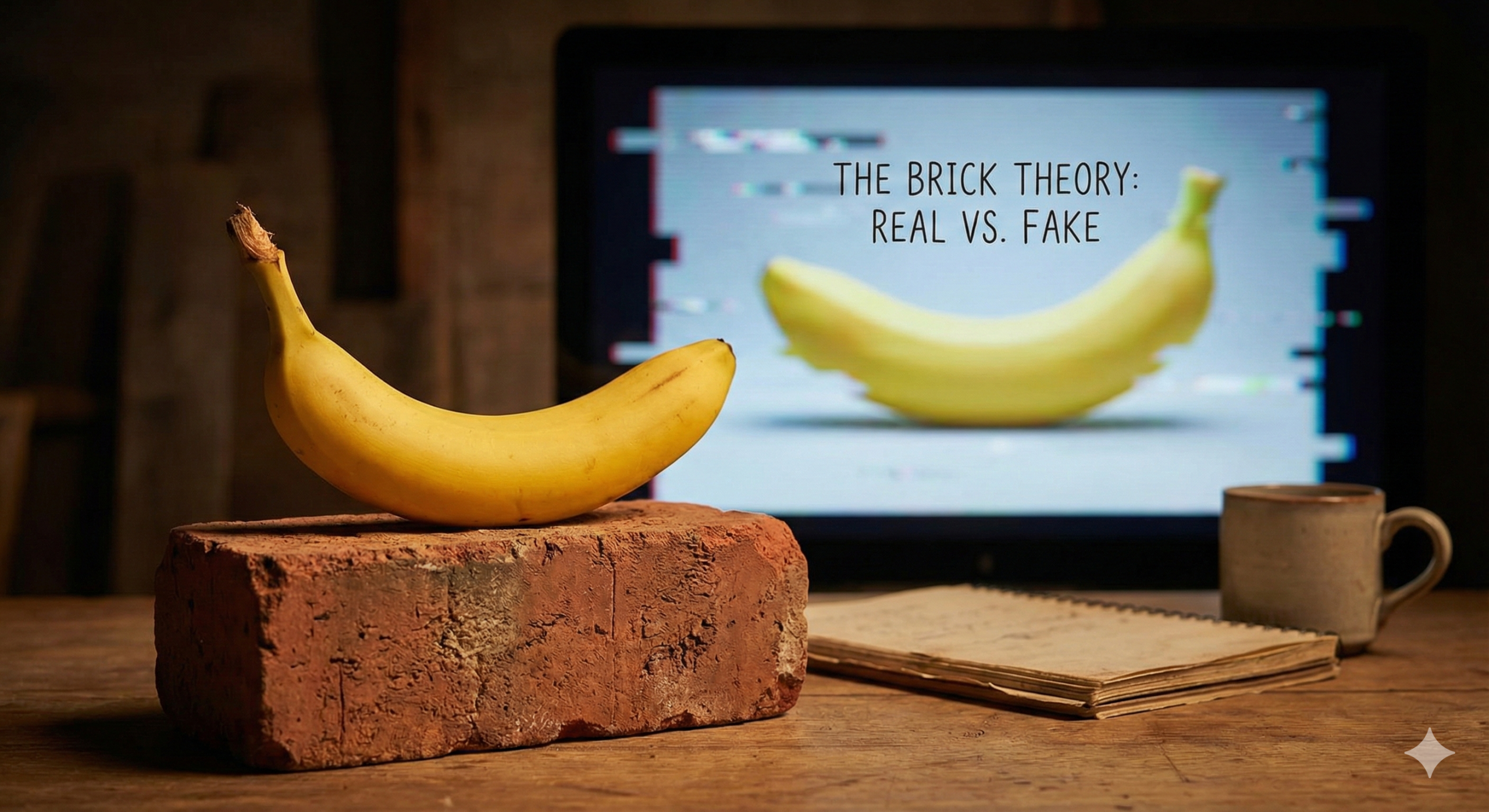
Let’s be honest for a second. We are living in a timeline that feels like a glitch in the simulation. We wake up every day to an epistemological nightmare—which is just a fancy way of saying that nobody knows what the hell is going on anymore. We live in a world where the fake is considered real, and the real is considered fake. Between ChatGPT writing heartfelt apology texts, “financial gurus” renting Lamborghinis to sell you a course on wealth, and Instagram filters snatching waists that don’t exist, it is becoming genuinely hard to determine what is truly tangible. I catch myself scrolling sometimes, looking at retouched images or reading “perfect” advice, and I question if we, as a society, can even identify “real” anymore. I’m not a guru or a therapist; I’m just a student of everything trying to make sense of the noise. And lately, the noise is loud. We are collectively suffering from reality fatigue, inundated with manufactured lifestyles to the point that when we finally encounter something authentic, we look at it with suspicion. So, I’ve been sitting with this question: What does “real” actually mean to me? In a world where everything is fluid and subjective, I had to find a baseline. When I think of things that are undeniably real—true in all forms, moral in morality, and just solid—I think of a brick.
Hear me out on this. I want you to visualize a standard red clay brick. When you hold a brick, there is no debate. You can feel it. It is heavy, solid, and rugged. You can’t gaslight me into thinking this brick is a marshmallow, and you can’t use a filter to make the brick look like a beach ball. The brick is. To me, “real” means objective reality—something that isn’t up for debate. But where society gets confused, and where the “fake” starts to creep in, is in the application of that brick. The brick itself is not up for debate, but the intent behind it is. You can use a brick to build a foundation for a house, representing construction and protection, or you can use that exact same brick to smash a store window, representing destruction and chaos. The brick didn’t change; the hands holding it did. I feel like we’ve lost the ability to separate the object from the intent. We applaud the person throwing the brick because it creates a “viral moment,” rather than the person quietly laying bricks to build a house because that looks boring.
This brings me to a quote my father always tells me: “Everyone steals and everyone lies.” It sounds incredibly cynical, I know, but honestly, it keeps me grounded because lying is a fundamental part of the human survival kit. We lie to ourselves about our diets, we lie to our kids about Santa Claus, and we lie to our bosses about why we’re late. Accepting that “everyone lies” removes the pedestal and stops me from looking for perfect people who don’t exist. However, just like the Brick Theory, how you use your lie is where I debate you. There is a massive difference between Survival Lying and Predatory Lying. If you tell people “I’m fine” when you’re battling depression to protect your inner peace, that is a boundary. But if your lie is a brick used to smash someone else’s window? Then I have an issue. I remember talking to a guy named “Mark” who bragged about “finessing” a business partner out of a few thousand dollars. He didn’t see it as stealing; he saw it as being “smart” and believed the other guy deserved to be taken for being naive. To me, that isn’t “smart”—it’s a character defect. But if everyone lies, the metric for a “good person” isn’t someone who never lies; it’s someone who never uses their lies to harm the ecosystem around them.
The wild part is, lately, scamming and exploitation have been rebranded as “real” in this society. We see it in the “Hustle Bros” podcasts and pop culture anthems—this pervasive idea that if you aren’t exploiting someone, you are the one being exploited. It’s a zero-sum game where “getting over” on someone is a badge of honor. To me, that is very different than just not vibing with your neighbor. I can choose to keep my distance without wanting to rob you. And it’s not just money; it’s identity. We see AI tools retouching images that are used as actual profile pics on dating sites, generating mathematically “perfect” faces. I feel like this is a trauma response for a society that hates itself. We are so afraid of our own “brick”—our heavy, rugged, imperfect selves—that we build a digital avatar to interact with the world for us. So, you have a guy who lies about his finances matching with a woman who lies about her appearance, and they go on a date wondering why the connection feels hollow.
With all this going on, I just wonder: Where is the opportunity for a person to simply have good morals? Don’t scam friends, don’t lie to hurt people, don’t cheat just because you can. I feel like that person gets overlooked or branded as “passive” or “weak.” If you aren’t “finessing,” people assume it’s because you don’t know how, not because you are choosing not to. But I would argue that morality is the ultimate form of strength. Restraint is not weakness. Holding the brick and choosing not to throw it through the window requires more control than throwing it does. If you feel invisible because you’re just good, I want you to know that you are the foundation. The scammers and the fakers are the balloons—they look big and colorful, but one prick and they are gone. You last.
So, how do we navigate this? We need practical scripts to stay solid when the fake world presses us. If a friend or coworker approaches you with an “opportunity” that feels like a pyramid scheme or a corner-cut, don’t be afraid to say: “Let’s be honest. I value our friendship, but I feel like the vibe on this is a little off for me. I keep my circle and my moves pretty solid—like a brick—and this feels a little too fluid. I’m going to pass.” If you are on a date and the person is performing—name-dropping or selling a fantasy—cut through the noise: “Can I be real with you for a second? I feel like I’m getting the ‘Instagram’ version of you right now. I’m looking for the heavy stuff—the real stuff. Can we drop the presentation and just talk?” And if someone tries to bond with you by tearing down someone else, shut down the gossip trap: “I hear what you’re saying, but honestly, I don’t know enough about their situation to speak on it. I try to keep my side of the street clean.”
What is happening to our society is that we are forgetting the weight of the brick. We are trading long-term respect for short-term attention and deep connections for high-engagement algorithms. But here is the good news: Real recognizes real. It might feel lonely sometimes, and it might feel like the scammers are winning. But the laws of physics apply to life, too. Gravity eventually wins. The balloons eventually pop. The filters eventually glitch. And when the dust settles, the only thing left standing is the brick. My advice to you is to do the work. Figure out why you might be attracted to the shiny, fake things. Check your own behaviors—are you using your bricks to build or to destroy? It is hard to determine what is truly real in this world, but you can always determine if you are real. Stay solid.